Long-term debt at year-end: amortization schedule, current portion and accrued interest
When we take over a file from another firm, long-term debt is almost always the first place we find discrepancies. The calculations are wrong, the current portion was never separated from the long-term portion, and everything often rests on an Excel workbook where an error has crept in. For the accountant reviewing the file, that kind of error is next to impossible to see.
Yet a loan touches three parts of the financial statements. On the balance sheet, it splits between current and long-term. On the income statement, it produces an interest expense. In the notes, it calls for the rate, the maturity, the security given and the repayments for the next five years. All of it comes from a single document, the loan's amortization schedule.
The four parameters of a loan
A loan with equal payments is described by four values: the amount borrowed, the annual interest rate, the number of payments and the periodic payment.
Knowing three is enough to find the fourth. That comes in handy when the contract cannot be found: with the amount, the number of payments and the withdrawal you see on the bank statement, you can work back to the rate.
The payment is calculated with the annuity formula:
Payment = M × i ÷ (1 − (1 + i)−n)
where M is the amount borrowed, i the rate per period (the annual rate divided by the number of payments per year) and n the number of payments.
Take a delivery truck financed for $68,500 at 6.99% a year, over 72 monthly payments. The monthly rate is 6.99% ÷ 12, or 0.5825%, and the payment is $1,167.53 a month.
The amortization schedule, payment by payment
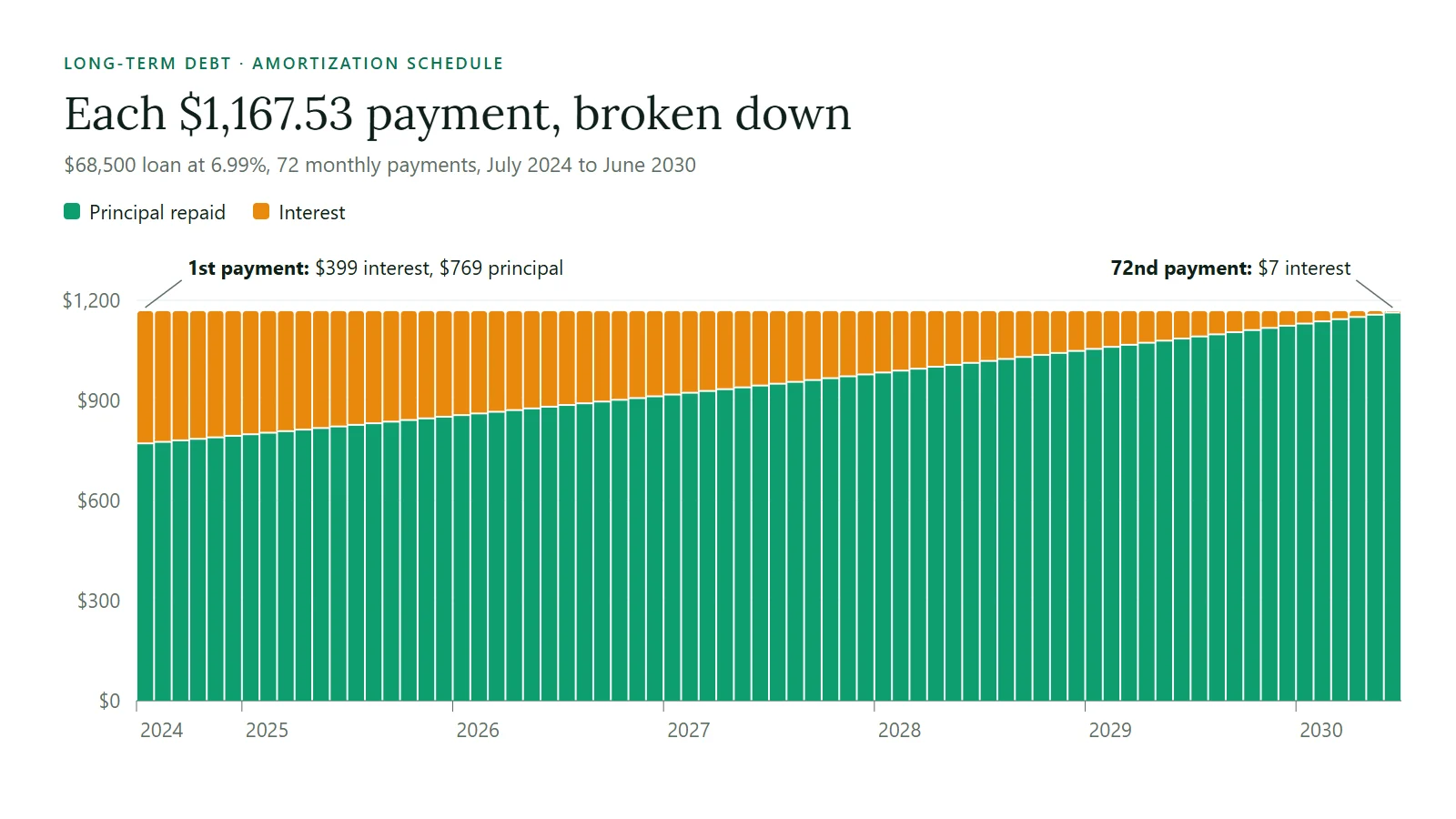
Each payment first covers the interest on the remaining balance. The rest repays principal. Early in the loan, interest takes a good share of the payment, then it shrinks as the balance goes down.
For each line of the schedule, you calculate the interest (balance before the payment × rate for the period), then the principal repaid (payment − interest), then the new balance (balance before the payment − principal repaid).
The truck loan is signed on June 15, 2024, and the first payment falls one month later:
| Date | Payment | Interest | Principal | Balance |
|---|---|---|---|---|
| July 15, 2024 | $1,167.53 | $399.01 | $768.52 | $67,731.48 |
| August 15, 2024 | $1,167.53 | $394.54 | $772.99 | $66,958.49 |
| September 15, 2024 | $1,167.53 | $390.03 | $777.50 | $66,180.99 |
And so on until the 72nd payment, on June 15, 2030, which pays off the loan.
The year-end numbers
Take the fiscal year ending December 31, 2025. Everything you need can be read from the schedule.
| Item | Amount |
|---|---|
| Balance at the start of the year (December 31, 2024) | $63,821.22 |
| Principal repaid in 2025 (12 payments) | $9,861.21 |
| Interest paid in 2025 | $4,149.15 |
| Balance at year-end | $53,960.01 |
The current portion
The current portion is the principal that will be repaid in the 12 months following the balance sheet date. It does not include the total of the payments: future interest is not a liability on the balance sheet.
| On the December 31, 2025 balance sheet | Amount |
|---|---|
| Current portion (2026 principal) | $10,573.02 |
| Long-term portion | $43,386.99 |
| Total | $53,960.01 |
Accrued interest
The last payment of the year was made on December 15. Between December 15 and 31, 16 days of interest built up without being paid. It is calculated pro rata by the number of days:
$53,960.01 × 6.99% × 16 ÷ 365 = $165.34
It is recorded by debiting interest expense and crediting accrued liabilities. On a truck, the amount looks negligible. On a million-dollar mortgage paid on the 1st of the month, it is 30 days of interest.
The notes to the financial statements
The notes describe each loan: the lender, the rate, the payments, the maturity and the security given. They also present the principal repayments expected for each of the next five fiscal years. For the truck:
| Fiscal year | Principal to repay |
|---|---|
| 2026 | $10,573.02 |
| 2027 | $11,336.23 |
| 2028 | $12,154.51 |
| 2029 | $13,031.87 |
| 2030 | $6,864.38 |
Added together, the five years give the year-end balance. If they don't, the schedule has a problem.
Why there are almost always discrepancies
The most common case: in the year's bookkeeping, each payment was posted in full to the loan account. At year-end, the loan account in the trial balance is then lower than the schedule balance, and the difference equals exactly the year's interest.
In our example, the loan account would show $49,810.86 instead of $53,960.01. The $4,149.15 difference is corrected with an adjusting entry that debits interest expense and credits the loan account.
When the difference does not match the interest, look elsewhere: a missed or duplicated payment, an extra repayment, a loan refinanced during the year. Very often, the workbook itself is to blame, with an overwritten formula, a line that no longer points to the right cell or a rate changed by mistake the year before. Those errors leave no visible trace and carry over from one year to the next.
When the whole debt becomes current
Under Accounting Standards for Private Enterprises (ASPE), classification is based on the facts at the balance sheet date. In three situations, the entire balance becomes current, even if the schedule runs over several years.
The first: the loan is payable on demand, and the lender can require repayment at any time (Section 1510, paragraph 13). The second: a covenant is breached at the balance sheet date, and the lender has not waived in writing its right to demand repayment for more than a year (Section 1510, paragraph 14). The third: the term matures within 12 months, such as a mortgage up for renewal, unless the renewal or refinancing is completed before the financial statements are finalized.
The contractual schedule is still used for the notes. The balance sheet, however, presents the debt as current.
Special cases
Residual value. Some loans and leases end with a larger final payment, the balloon or the purchase option. The periodic payment is then lower, and the residual balance becomes current in the year it falls due.
Payment at the beginning of the period. With a lease, the first payment is often made at signing. It goes entirely to principal, since no interest has accrued yet.
Payment deferral. During a principal holiday, the borrower pays interest only, and the maturity is pushed back accordingly. During an interest holiday, it's the opposite: the whole payment goes to principal.
Early repayment. When a loan is refinanced or paid off before term, the schedule stops at the payoff date. The balance on that date is the amount repaid.
Merchant cash advance (MCA). These financings show no interest rate. The business receives an amount, then repays a fixed amount in weekly payments. For example, it receives $10,000 minus $250 in fees, and repays 26 payments of $500, or $13,000. To account for it as debt, you record the net amount received ($9,750), then find the implicit rate that matches the payments to that amount. Here, it exceeds 117% a year. If you record the gross amount instead, or the bank deposit when an earlier advance was paid off along the way, the interest is wrong.
Which clients is the long-term debt worksheet best for?
The long-term debt worksheet is best for clients who have debts to track from one year to the next. Tracking them is often very hard: each loan has its own rate, payments and maturity, and in the books the interest gets mixed in with the principal.
- Best for clients with several loans: a truck, equipment, a mortgage. Each loan has its own schedule, and the discrepancies hide in the total.
- Best for leases and loans with a residual value: the larger final payment changes the current portion in the year it falls due.
- Best for files taken over from another firm: with three parameters from the contract or the bank statement, you rebuild the schedule, and the gap with the workbook shows up right away.
- Best for merchant cash advances (MCA): the implicit rate, like the 117% in the example above, is calculated from the net amount received.
- Less useful for a line of credit with no fixed payments: there is no schedule to build, and the balance comes straight from the year-end statement.
For a single simple loan, the lender's schedule already gives the basic numbers. The worksheet is then mostly useful for the adjusting entry, the accrued interest and the note to the financial statements.
How Ledger handles it
We built Ledger's long-term debt worksheet to replace those fragile workbooks. The calculations cannot be changed by mistake, and each loan follows the file from one year to the next.
You enter three of the four parameters from the contract, and a button calculates the fourth. Ledger then produces:
- the complete amortization schedule for each loan, exportable to Excel;
- the year's summary, with the opening balance, principal, interest, closing balance and the difference with the trial balance;
- the split between current and long-term, including for demand loans;
- the year-end accrued interest, if you turn it on;
- the adjusting entry, ready to post to the trial balance;
- the repayments for the next five fiscal years and the note to the financial statements.
The special cases (residual value, lease, payment deferral, early payoff, merchant cash advance) are handled in the same window.
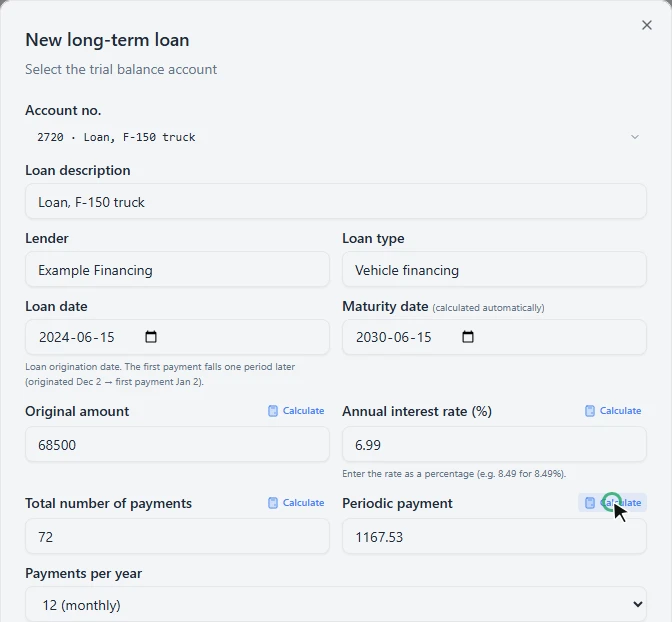
The step-by-step guide, with the video, is in the help centre: the Long-term debt worksheet.
Try Ledger free for 45 days
No credit card, with a one-hour video conference walkthrough to get you started.
Start my free trial →Reference: CPA Canada Handbook, Part II, Accounting Standards for Private Enterprises, Section 1510, Current Assets and Current Liabilities. Fictional example. This article is general in nature and does not replace advice tailored to your situation.